


Global bond sell-off spreads as yields rise amid 'collection of shocks'
Global bond sell-off spreads as yields rise amid 'collection of shocks'

Jake ConleyMon, October 5, 2026 at 6:08 PM UTC
0
Perhaps the biggest story in the markets over the past month has been the meteoric run-up in US Treasury yields, putting increasing pressure on the US economy.
But the challenge is not just in the US — the global bond complex remains deep in a sell-off as governments stare down surging energy prices, booming deficits, a shifting US tariff regime, and economic growth running hot despite a number of headwinds.
"Until recently it was plausible to argue that higher yields were also driven by strong growth. However, last week's market moves demonstrated that this is no longer simply a 'strong growth' story," Deutsch Bank Henry Allen wrote to clients. "Bond markets are starting to recognise that the collection of shocks we're seeing are unlikely to prove temporary."
Read more: How soaring Treasury yields could hit your finances
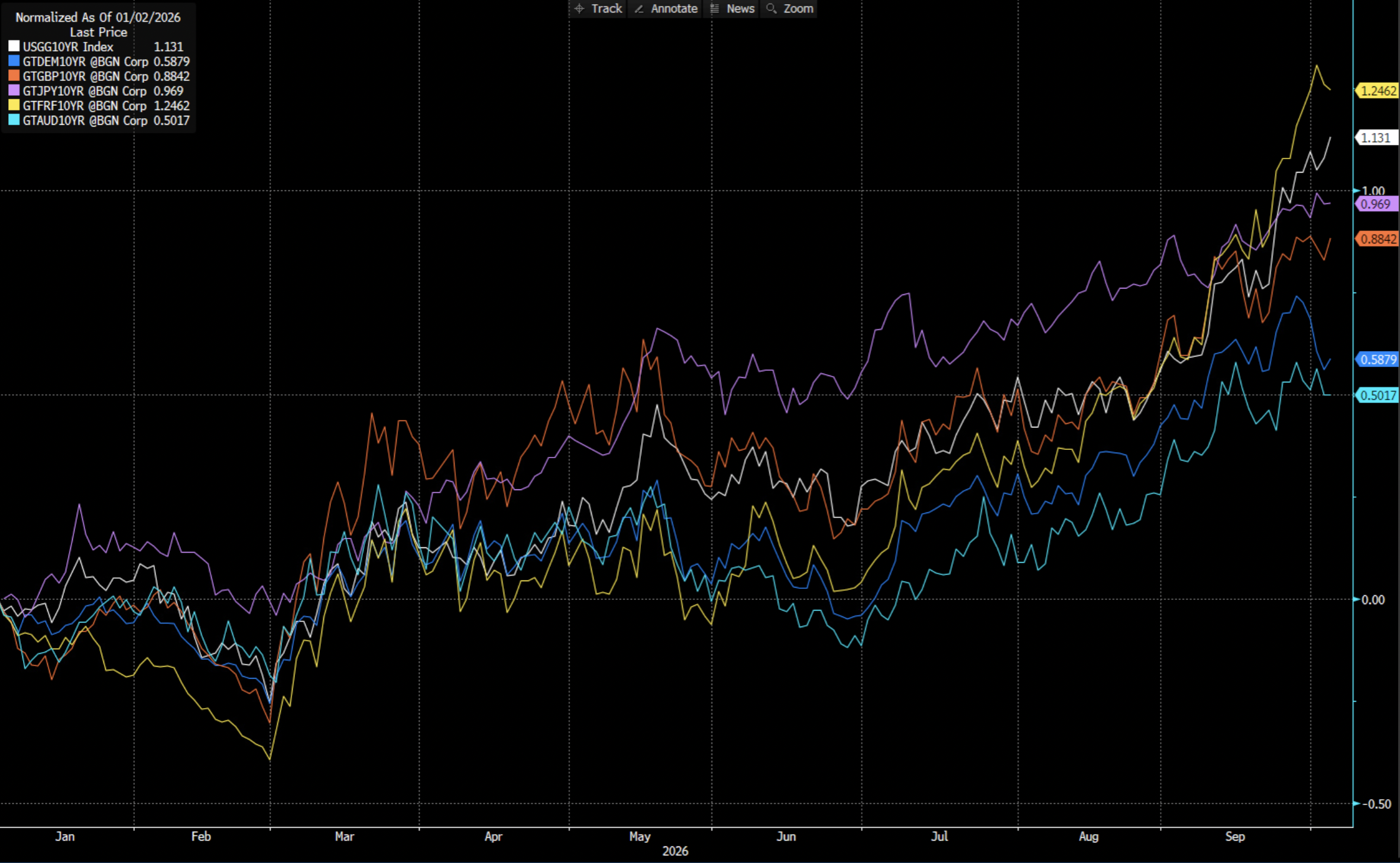
Yields on 10-year government bonds across the globe have risen nearly in tandem.
The pressures on the global sell-off are manifold and compounding.
Most prominently, the war in Iran has sent global energy prices soaring, contributing to inflation worldwide and shifting investor expectations for central banks to keep rates higher for longer. Futures on Brent crude (BZ=F), the international pricing benchmark, have held at or near $100 per barrel for much of the year since their initial run-up in early March as the oil market prices in the potential for further disruption, even as crude exports normalize to prewar levels.
At the same time, major world governments are facing ballooning national debt and widening budget deficits, forcing them to issue more debt just as investors demand higher yields to absorb it.
In the US, the 10-year Treasury (^TNX) — often cited as the most critical number in global finance for its widespread use as a benchmark — has climbed by more than 110 basis points this year, rising to levels not seen since 2002 after crossing a 2007 pre-global financial crisis high. On the longer end of the US issuance spectrum, the 30-year Treasury yield (^TYX) reached its highest level since 2002 last week.
While the impulses are much the same globally as in the US, each country faces unique pressures on the rates markets.
In France, political leaders at the Élysée Palace are staring down a burgeoning fiscal crisis, as a revolving door of prime ministers and an austerity budget proposal calling for shrinking the national deficit have prompted a lack of confidence in the leadership. The French presidential election in 2027 threatens to drastically shift the political landscape in Paris, as the far-right National Rally party has performed well in polling.

Marine Le Pen, French far-right leader and member of parliament, who is running in the 2027 French presidential election for the Rassemblement National (National Rally), delivers a speech in Henin-Beaumont, France, on Sept. 13, 2026. (Reuters/Sarah Meyssonnier)
Since the start of the year, France's 10-year government OAT yields have risen by roughly 130 basis points, while the spread between French debt and German debt — typically seen as more stable — has widened to levels near those seen during the eurozone crisis in the early 2010s.
Advertisement
In Japan, persistent inflation and wage growth have pushed the country's central bank to raise rates, breaking a decades-long period of ultralow lending costs as yields have risen. At the same time, Japan's currency crisis over the past few months has seen the yen fall sharply in value and pushed up imported inflation, putting pressure on the BoJ to raise rates even faster.
The yield on Japanese 10-year bonds has jumped by around 100 basis points, while the yen remains weak despite a major intervention by the Japanese government and the US Treasury Department.
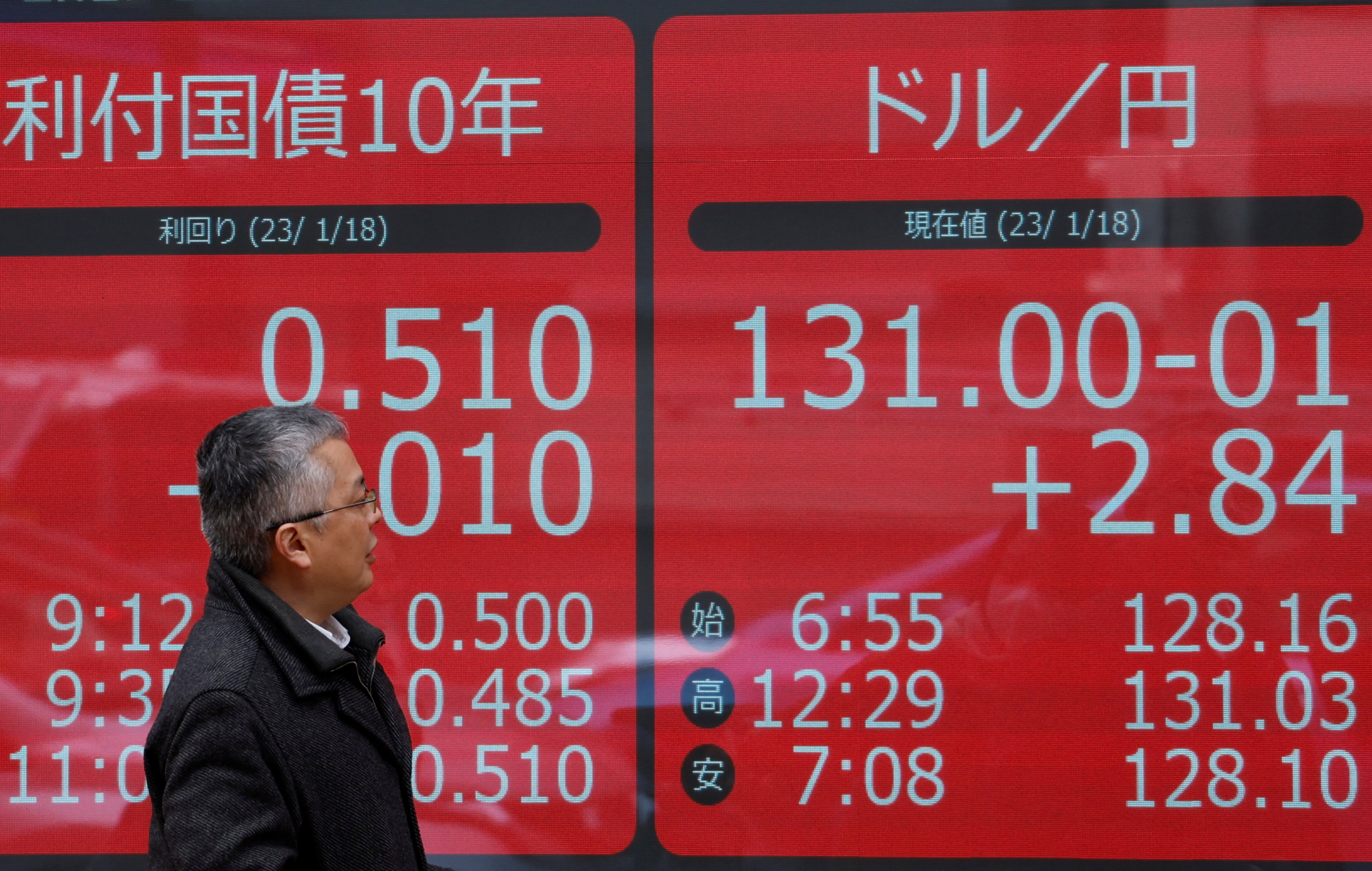
A man looks at electric monitors displaying Japan's 10-year government bond yield on gilts and the exchange rate between the Japanese yen against the US dollar outside a brokerage in Tokyo, Japan, on Jan. 18, 2023. (Reuters/Issei Kato)
Energy prices have kept pressure on the UK and German economies by driving up the cost of imported gas, which both countries rely on. The European Central Bank issued a quarter-point rate hike in September, while the Bank of England has held back on moving rates so far, but has warned that persistent energy pressures could push the Monetary Policy Committee to raise rates.
Yields on UK 10-year gilts and German 10-year bunds have risen around 80 bps and 60 bps, respectively. Ten-year Australian government bonds have climbed by roughly 50 bps as well, as Canberra faces sticky domestic inflation, a tight labor market, and the additional inflationary impulse of the war in Iran.
All that said, there are positive impulses pushing up rates globally.
The global economy is growing at a steady rate, as recent PMI readings throughout the developed world have shown "global growth momentum is both strong and broad-based," per JPMorgan Chase. A global composite PMI compiled by JPMorgan rose to 54.3 in September, the index's highest level in four years, "reinforcing the view that global activity is expanding at an above-trend pace," analysts said.
In the US specifically, the AI build-out has set off one of the largest capital investment cycles on record, which is holding up the equity market, though the AI boom is steadily spilling into other markets.
But a growing economy means investors expect higher returns on capital and typically pushes central banks away from rate cuts. Taken together, both the expected path of short-term rates and the term premium are moving higher, pushing long-term yields up across developed markets.
Jake Conley is a breaking news reporter covering US equities for Yahoo Finance. Follow him on X at @byjakeconley or email him at jake.conley@yahooinc.com.
Click here for in-depth analysis of the latest stock market news and events moving stock prices
Read the latest financial and business news from Yahoo Finance
Source: “AOL Money”
