


MLB's doomsday clock running out as World Series brings imminent war into focus
MLB's doomsday clock running out as World Series brings imminent war into focus

Bob Nightengale, USA TODAYSat, October 24, 2026 at 12:19 AM UTC
0
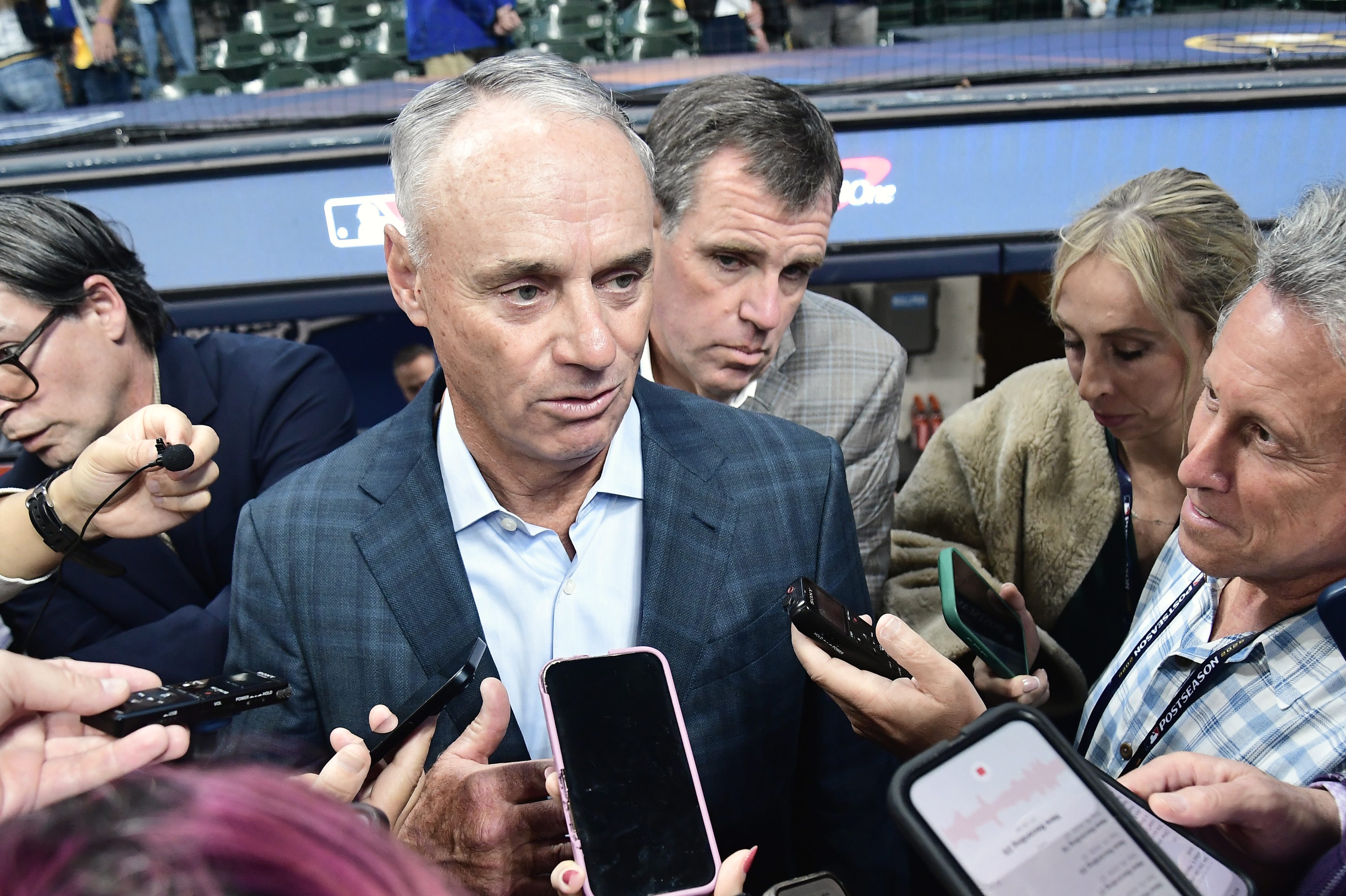
MILWAUKEE — Just two hours before the start of the small-market, low-payroll World Series, commissioner Rob Manfred reiterated that Major League Baseball needs a salary cap and that the Milwaukee Brewers' presence backs up the owners' stance.
“I think the small markets operate at a disadvantage economically," Manfred said. “They just don't have the resources that our bigger markets do. I mean, (here’s) the best evidence. Look, the Brewers have been a well-run franchise forever. It's been 40 years since we're here.
“Once every 40 years is not enough."
Despite the Tampa Bay Rays having the fifth-smallest payroll and the Milwaukee Brewers having the 11th-smallest, winning 201 games between them, it doesn’t change the owners’ view that there needs to be a cap on player payrolls.
“Look, no one ever said that differences in economics are perfectly outcome determinate," Manfred said. “If you look at the data, our larger markets have a very statistically significant advantage in terms of making the playoffs and going deeper in the playoffs."
A small-market World Series may wreak havoc on TV ratings, but Manfred insists this matchup is good for baseball. He just wants to see it happen more often.
“It’s good for baseball to have two small markets like this,’’ Manfred said. “It shows that we leave a lot on the table in some of our smaller markets by not having them have an opportunity to compete on a regular basis.’’
Bruce Meyer, executive director of the Major League Baseball Players Association, vehemently disagrees with Manfred’s stance, believing the only reason the owners want a salary cap is to increase their profits.
“I think the fact that they're doubling down on the cap now, in the wake of what's happening with this World Series,’’ Meyer said, “just illustrates that it's not about competitive balance. It's not about teams not having hope. It's about their desire − which they've had for decades − to have a system that artificially suppresses player salaries, player freedom of movement removes player guarantees, and limits flexibility in all different areas, guts the amateur entry system.
“You know, the rest of it is a charade. I mean, they don't really want it for any of the reasons they say."
More: Brats, beers and best friends: World Series tailgates prove Brewers are Wisconsin's team
While MLB and the union continue to have talks on non-economic issues before the collective bargaining agreement expires Dec. 1, Manfred said that there are more hang-ups than simply the union’s refusal for a salary cap.
“Everybody's focused on the fact you have a salary cap on the table,’’ Manfred said, “and he doesn't like that. Well, he has a whole lot of proposals on the table that we don't like. So, you know, we're going to have to get through that.’’
Is it at all possible to resolve this without a lockout beginning Dec. 1 that could threaten the start of the 2027 season, resulting in missed games because of a labor dispute for the first time since 1995?
“Look, people can be entrenched wherever they want to be entrenched," Manfred said. “You know, we're prepared to commit ourselves to the process. … Re-thinking where you are is a really important part of trying to make a deal, and it's actually a skill in collective bargaining.
“You know, it's easy to say I'm here and I'm never moving. That's not a particularly skilled approach to the process.’’
It was a direct criticism of Meyer’s negotiating style, but then again, Manfred didn’t see Meyer approach Milwaukee Brewers owner Mark Attanasio in the dugout before the game, stick out his hand, and say: “Ready to make a deal.’’
Advertisement
Attanasio, a prominent member of MLB’s labor relations committee and a candidate to become the next commissioner, was criticized along with other owners by Meyer earlier when he talked to a small pocket of reporters for nearly 30 minutes.
“It’s kind of sad that the league and the owners have once again been focusing not on the greatness of the game, not on the greatness of the players, not on the greatness of the playoffs,’’ Meyer said, “but they've been focusing on basically telling the consumers of their product that the product is broken. They continue, including the owner of the Brewers.
“I just saw him say, well, fans still don't have enough hope. They have the best record in baseball two years in a row. They made the playoffs eight out of nine years. They’re favorites to win the World Series. It’s such a shame.’’
Now, all of those good feelings could be crashing down with an expected lockout on Dec. 1.
“None of this has to be happening," Meyer said. “The owners made a choice. They're going to make a choice, presumably to lock the players out. They're not required to do that. They're apparently going to once again stop promoting the game during the lockout and pull players' pictures off the websites. That's a choice that they're making.
“Their decision to again come out years in advance talking about how they want the ultimate restriction on players, which they know led to a horrible work stoppage last time. That's a choice they made.
“In negotiations, they've made clear that at this point they're not willing to talk about anything outside of their cap system. So, none of this has to be happening.’’
Still, despite the huge divide over the salary cap, Manfred insists he’s optimistic, knowing that no games have been missed over a labor dispute in more than three decades.
“Look, no fan wants to miss games," Manfred said. “Obviously, we don't want to miss games either. I'm not prepared to write the process off as ending in a really ugly labor battle. I believe in the process of collective bargaining. I think if people approach the table, not with preconceived notions of about what has to happen, and commit to the process that we can make an agreement without having a disruption. …
“You got to commit yourself to the process. People have to be flexible in terms of what they're willing to talk about, what they're willing to consider, and you know we've been fortunate over the recent decades. We found a way to work it out, and I'm hopeful we'll be able to do it again this time.’’
While the Rays and Brewers World Series certainly illustrates that there's still hope for small markets to be on baseball’s greatest stage, which delights the union, it also shows that teams don’t have to spend money lavishly in the free-agent market, which delights the owners. Brewers DH Christian Yelich and pitcher Brandon Woodruff are the only players in the World Series earning more than $20 million. The Rays don’t have a player earning more than $12 million.
The system works just fine, with the game prospering like never before, Meyer insists. He says a salary cap will continue to be a non-starter in serious talks, in which he believes players will remain unified in that belief
“There's a lot of misunderstanding about what it means for players,’’ Meyer said. “In fact, it would drain billions of dollars from the pockets of players. I see this notion frequently online that, you know, well, a cap would be good for players. It's just not true, and I don't fault fans for not understanding that. …
“The salary cap is the opposite of competition. The salary cap tells teams you can't compete too much. You can only compete a little bit, but if you try to compete too much, then you know you're not allowed to do that. So I believe that that system is bad for fans. It doesn't allow teams the flexibility to do the things that they want to do that they believe is in the interest of their fans to put a put a better team on the field.’’
Meanwhile, talks continue to permit MLB players to participate in the 2028 Olympics in Los Angeles while the ABS challenge system was viewed as an overwhelming success and will remain in 2027.
"I think that from Major League Baseball's perspective, we'd like to participate in the Olympics,’’ Manfred said. “The MLBPA has been having conversations about player-related issues, hotels, tickets, whatnot, with LA28 for a substantial period of time, and we're hoping that they get those negotiations moving and wrapped up.’’
Follow Nightengale on X: @Bnightengale
This article originally appeared on USA TODAY: MLB's doomsday clock running out as World Series brings imminent war into focus
Source: “AOL Sports”
