


The awful story of the world’s most cursed cruise ship
The awful story of the world’s most cursed cruise ship

Chris LeadbeaterWed, July 1, 2026 at 10:18 AM UTC
4
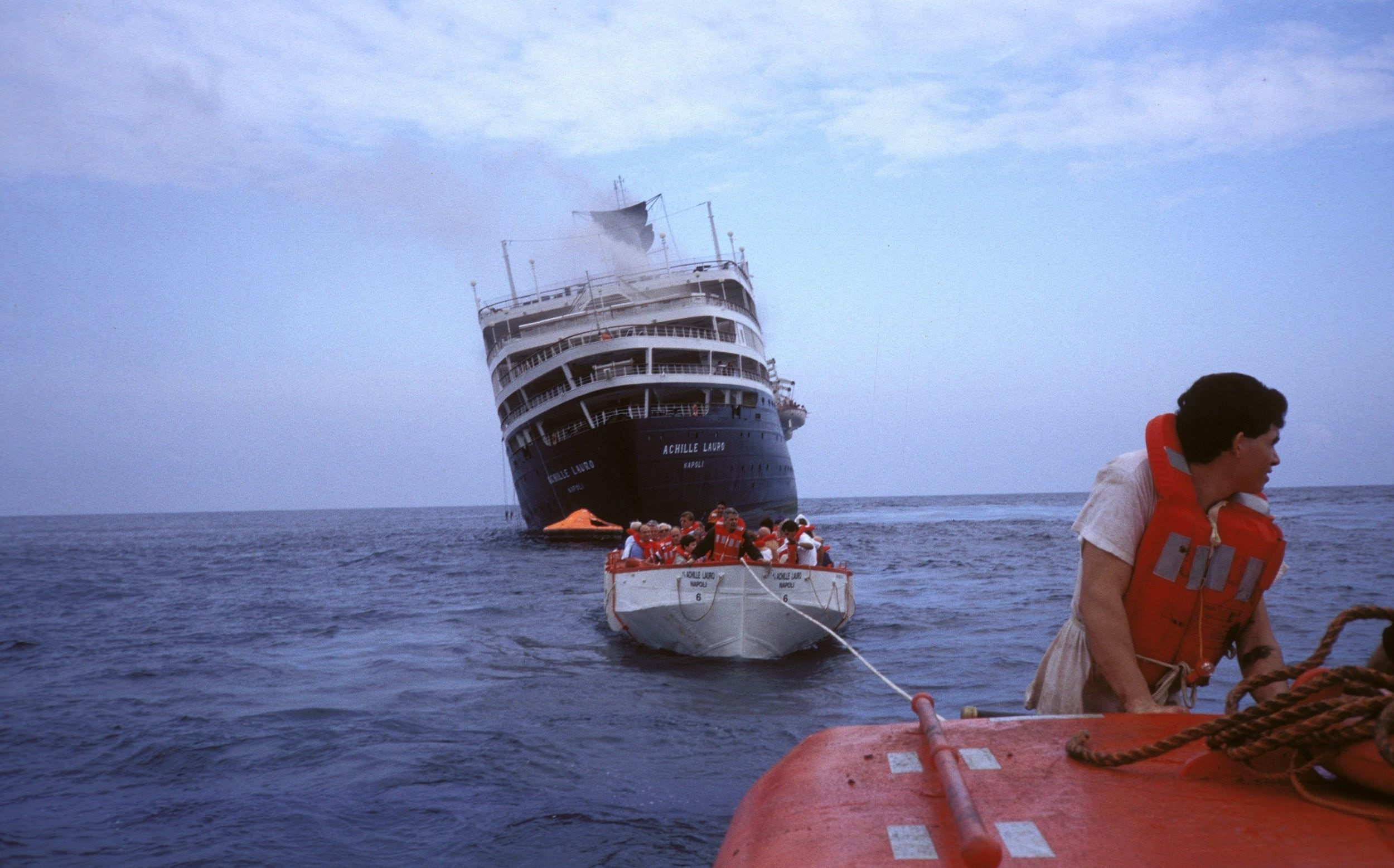
The StarLauro caught fire on Nov 30 1994 off the coast of Somalia - Gamma-Rapho/Getty Images
The history of the world’s great passenger ships is littered with corpses.
Every last detail has been wrung from the tale of the Titanic, but the disaster has lost none of its tragedy. The sinking of Italian liner the SS Andrea Doria remains a source of controversy 70 years after the event. And while the Costa Concordia avoided a deep-water grave in 2012, it could not escape its captain’s recklessness, or the scrapyard – proof that cases of maritime misadventure are not confined to the 20th century or the reels of Hollywood blockbusters.
However, most doomed vessels tend to encounter significant ill-fortune just once, and conclusively. The MS Achille Lauro, in grim contrast, made an unpleasant habit of it. Over the course of nearly five decades on the oceans, it met with catastrophe and calamity on an astonishingly regular basis, as if they were familiar friends. It tended to draw others into its maelstrom of despair in the process. To describe it as “the world’s most cursed cruise ship” might sound hyperbolic, but it wouldn’t be too far from the truth.
Power and elegance in tandem
Its story began eight decades ago today, on July 1, 1946.
There in the first post-war summer on a bloodied planet, it was launched at the De Schelde shipyard in Vlissingen, near the southern end of the Dutch coast. It slipped into the Scheldt estuary as the Willem Ruys, one of the last grand vessels of the age of ocean liners.
It was a relative giant, at 630ft (192m), it was roughly three-quarters the length of the Titanic (although only half that liner’s size, at 21,119 Gross Registered Tons). It had eight Swiss-built engines to turn two propellers. And it had space for up to 900 passengers. Power and elegance in tandem.

The Achille Lauro was formerly named the Willem Ruys after the 19th century Dutch businessman’s grandson - Francois Lochon/Gamma-Rapho
It would be easy to wish the ship a happy 80th birthday, but very little of what followed its launch was happy.
Even its original moniker was a source of considerable sorrow. At first glance, you might assume that it was a tribute to Willem Ruys, the 19th century Dutch businessman, who had founded the shipping line Royal Rotterdam Lloyd in 1875, aiming to take advantage of the new sailing routes that had been made possible by the opening of the Suez Canal in 1869.
But in fact, the liner’s name was a direct reference to Ruys’s grandson – also called Willem. And by July 1, 1946, the young man was dead. He had been taken hostage during the German occupation of the Netherlands, and had been shot.
The liner was overdue. In this, the shipyard was blameless. Construction had begun in January 1939, but the war had intruded, and the best part of nine years had passed before the Willem Ruyswas ready to depart on its maiden voyage (on December 2, 1947). In the interim, the world had shifted. Not only had an international conflict torn it apart, but the colonial era had come crashing down in the firestorm.
In 1939, the plan had been for the ship to work the sea lanes to the Dutch East Indies, but what is now Indonesia had declared independence on August 17, 1945 – prompting four years of violence which ended with its emergence as a sovereign state in December 1949. Not only was the Willem Ruys late to its own party; the chairs were being stacked away by the time it rang the doorbell.
Trouble in the Red Sea
The East Indies route was not erased from the timetable by Indonesian nationhood, but passenger numbers declined sharply, and by the early 1950s, the voyage to Jakarta was much less respected than it had been in the 1930s. The events of January 6, 1953 hardly helped it to reinvigorate its fading lustre.
The Willem Ruys had a close rival in the Indian Ocean – the MS Oranje, which sailed in the service of Royal Rotterdam Lloyd’s direct competitor the Netherland Line. And on that winter day, the two ships came far too close.
The rivalry was not unfriendly, and at the time, it was common practice for ships of a kindred purpose to engage in an amicable salute when passing in opposite directions, narrowing the distance between them to the sort of short gap that would allow passengers on each deck to wave to each other.

The MS Oranje pictured in 1960, four years after its run-in with the Achille Lauro - Getty
On that January 6, that gap was non-existent. The MS Oranje, heading south-east towards Colombo and then Jakarta, was travelling too fast for the manoeuvre to be viable. The Willem Ruys, going home through the Red Sea, made an unexpected swing to the left, and contact was made. The Oranje came off worse, sustaining damage to its bow, but managed to limp to Indonesia, avoiding Sri Lanka for fear of being impounded. The Willem Ruys survived the hour, without learning the lesson.
Five months later came an awful echo. On June 26, 1953, it collided with Dutch tanker the Cornelis B near the Île de Batz, off the coast of Brittany. The dense fog that day provided mitigating circumstances – but no reprieve. Wounded by the impact, the Cornelis B sank.
Advertisement
A ‘fresh beginning’
The Willem Ruys and the MS Oranje would meet again. By 1958, they were stablemates, via a cooperation agreement between their owners to create a round-the-world passenger service. Together with a second Netherland Line vessel, the Johan van Oldenbarnevelt, the pair sailed the globe as the “Royal Dutch Mail Ships”.
As part of this, the Willem Ruys was extensively refitted – dispatched to the Wilton-Fijenoord dockyard on the edge of Rotterdam to be converted into a cruise ship. When it set off on a circumnavigation on March 7, 1959 – eastbound to Australia via the Suez Canal, then back via the Panama Canal – it was heavier (23,114 Gross Registered Tons) and bigger (with room for 1,045 passengers).
This period of stability did not last. In 1964, Royal Rotterdam Lloyd bowed to its falling passenger figures, and put the Willem Ruys up for sale. It was bought within months by Italian cruise company Flotta Lauro Lines (a precursor of MSC Cruises), rechristened in honour of the firm’s owner – Achille Lauro, the businessman and populist politician, – and put back to work.

Businessman and populist politician Achille Lauro, founder of Flotta Lauro Lines - Edoardo Fornaciari/Getty Images
Rebirth did not mean better fortune. In August 1965, the new MS Achille Lauro was eviscerated by an onboard explosion. A total rebuild was required.
Much as it did in 1946, the ship exited the dry dock into turbulent currents and geopolitical storms. In May 1967, it assisted in the evacuation of British families from Aden, as 129 years of colonial control at the lower tip of the Arabian Peninsula crumbled in the face of a Yemeni nationalist uprising. Days later, it just squeezed through the Suez Canal before the Six-Day War between Israel and an Arab coalition closed the waterway.
But if the vessel dodged these particular bullets, it continued to blunder into problems elsewhere. In 1972, the Achille Lauro was further adapted for cruising and fell victim to fire once more during the refurbishment. On April 28, 1975, it played its calling card again, smashing into the Lebanese cargo ship Youseff in Turkish waters, sending this unfortunate vessel, laden with cattle, to the bottom of the Dardanelles strait.
It took six further years for an on-board fire to break out, in 1981 – but no sooner had this been extinguished than, in 1982, the Lauro Line went bust. Without the funds to continue, the Achille Lauro found itself laid up in Tenerife. Here, at least, it could cause no more harm.
Blood on the deck
Yet the bleakest part of its story was still to come. In 1985, Greek shipping company the Chandris Line leased the vessel on a charter agreement. The decision was soon regretted.
The recent history of the Middle East is scarred by brutality, but even against this violent backdrop, what happened to the MS Achille Lauro in the autumn of 1985 was abhorrent.
On October 7, the ship was part-way through a short Mediterranean cruise between Egypt’s second city, Alexandria, and the Israeli port of Ashdod when – just outside Port Said, at the top of the Suez Canal – it was boarded by four members of the Palestinian Liberation Front.

The Achille Lauro leaves Port Said after being released from a terrorist hijacking in 1985 - Getty
Demands were issued at gun-point: the release of 50 Palestinians held in Israeli prisons, and the rerouting of the ship to Syria. When permission to dock in Tartus was refused, the hijackers took reprisals. A shuffling of the passports seized from British, Austrian and US passengers saw the singling out of Leon Klinghoffer, a 69-year-old Jewish American confined to a wheelchair after suffering two strokes. His execution was conducted within earshot of his wife, Marilyn Klinghoffer, his body thrown overboard.

Former president Ronald Reagan greets Marilyn Klinghoffer, widow of Achille Lauro 1985 hijacking victim Leon Klinghoffer - Diana Walker/Getty Images
Somehow, the stand-off ended via negotiation after four days (on October 10), with no further direct loss of life (although the traumatised Marilyn Klinghoffer succumbed to cancer within four months), and the Achille Lauro stuttered back into service, its identity partially camouflaged with a further rebranding – as the MSC vessel StarLauro – in 1989.
The final inferno
In the end, though, the ship’s propensity for bursting into flames would prove its undoing.
On the evening of November 30, 1994, as it was sailing parallel to the coast of Somalia, on its way to South Africa, a fire broke out in the StarLauro’s engine room. There were no witnesses to the blaze’s early flickerings, and by the time it was noticed, it could not be quelled.

The ship burst into flames for a final time in 1994 - AFP
Miraculously, only two people among the 979 passengers and crew died during the evacuation, the American warships USS Gettysburg and USS Halyburton riding to the rescue.
But there was to be no such salvation for the vessel born as Willem Ruys – and made notorious as the MS Achille Lauro. Increasingly listing as a result of its injuries, it disappeared below the surface on December 2. Its wreck has never been found.
Source: “AOL Entertainment”
