


Why nine million were removed from a landmark Indian cash scheme for women
Why nine million were removed from a landmark Indian cash scheme for women

Mayuresh Konnur - BBC Marathi; Zoya MateenMon, August 10, 2026 at 12:39 AM UTC
0
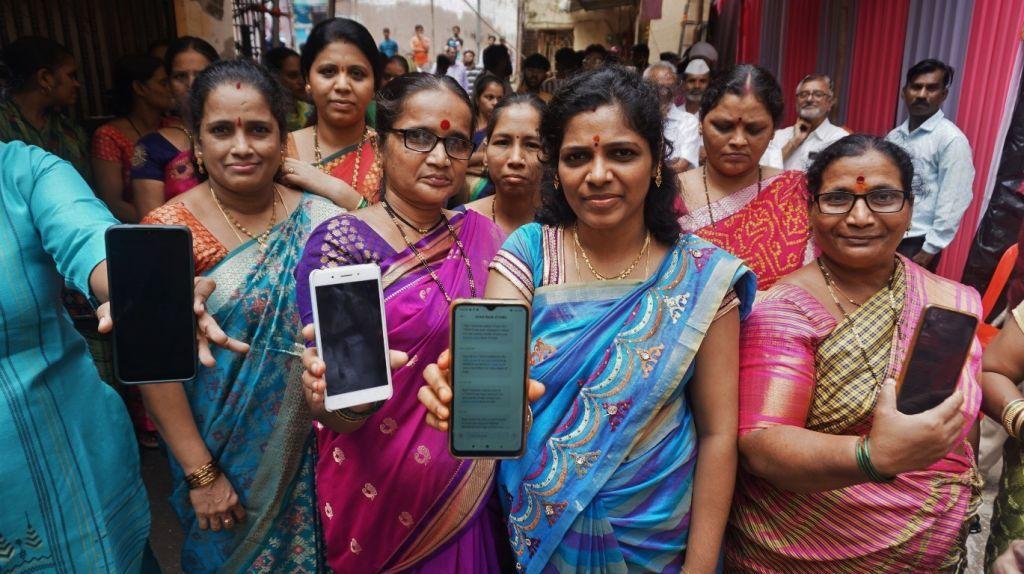
The scheme pays eligible women 1,500 rupees ($17; £13) a month
Until two years ago, Nirmala Bawaskar had no bank account of her own.
A widow who works as a housemaid in Maharashtra's Sambhajinagar district, she signed documents with a thumbprint and had little control over money entering her household.
That changed when she enrolled in the Mukhyamantri Majhi Ladki Bahin Yojana, one of India's biggest state cash-transfer schemes. Launched just months before the state's closely fought election in 2024, it pays eligible women 1,500 rupees ($17; £13) a month and became both a financial lifeline for millions and one of the state's most potent political symbols.
For Bawaskar, the modest monthly payment meant her first bank account and money she could call her own.
"Though it is a small amount, it really helped us, especially with medical expenses," she says. "I was so motivated by it that I even learned how to write."
Bawaskar is one of more than 26 million women enrolled in the scheme, which is now under scrutiny over its implementation.
Last month, India's national auditor said Maharashtra's Women and Child Development Department overspent its authorised budget by 35.41bn rupees, spending a total of 332.37bn rupees on Ladki Bahin in its first financial year.
Separately, a government verification drive removed more than nine million beneficiaries – mostly for failing to complete mandatory identity checks, while others were found to be ineligible.
The Maharashtra government has not responded publicly to the audit. Women and Child Development Minister Aditi Tatkare's office told the BBC that a verification drive and recovery of ineligible payments were continuing but did not address the auditor's findings.
When Maharashtra launched Ladki Bahin in June 2024, it said the monthly payments would boost women's financial independence and help families meet their everyday expenses. The scheme covered eligible women aged 21 to 65 from lower-income households, excluding income-tax payers, government employees and families already receiving similar welfare benefits.
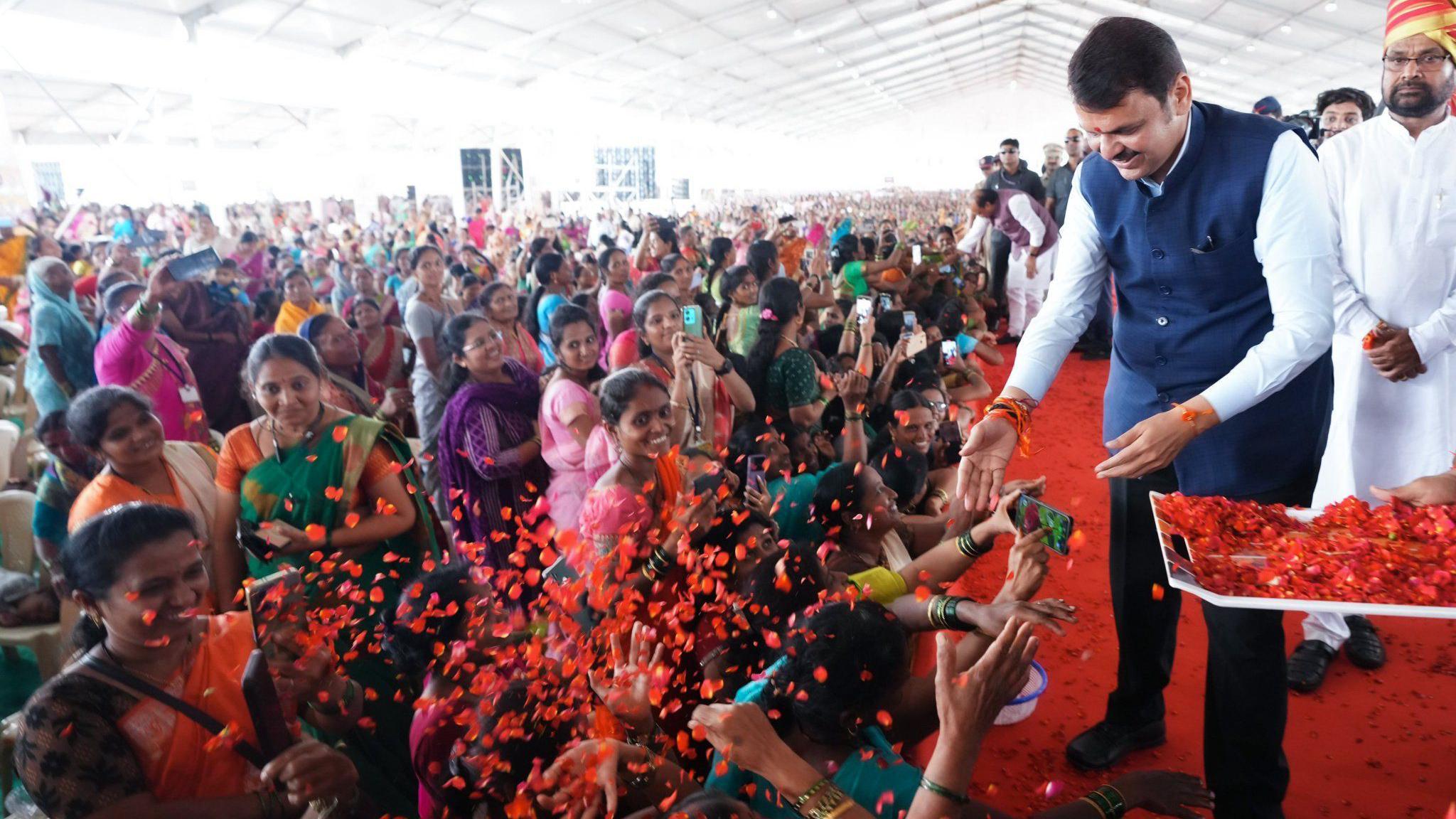
The Ladki Bahin scheme was announced by the ruling alliance ahead of the 2024 state elections
Its timing was politically significant. Announced after the ruling Mahayuti alliance – led by Prime Minister Narendra Modi's Bharatiya Janata Party and two regional allies – suffered setbacks in India's 2024 general election, Ladki Bahin became the defining issue of the state election five months later. The government cast it as recognition of women's unpaid work, while the opposition called it vote-buying even as it promised similar cash transfers of its own.
When Mahayuti returned to power with a much larger-than-expected majority, its leaders credited Ladki Bahin with helping secure the victory.
A post-election survey by Lokniti-CSDS suggested the scheme helped Mahayuti. Half the women surveyed voted for the ruling alliance, compared with a third for the opposition. Among Ladki Bahin beneficiaries, Mahayuti's support rose to 54%.
But researchers cautioned against overstating its impact. Women were only three percentage points more likely than men to back Mahayuti, making it too early to conclude they had emerged as a distinct bloc of welfare voters, wrote CSDS researcher Rajeshwari Deshpande.
Advertisement
A wage for housework? India's sweeping experiment in paying women
India's cash transfer boom gives relief to the poor but strains budgets
Maharashtra is not alone. Across India, governments led by different political parties have rolled out cash-transfer schemes for women, who now make up nearly half the country's electorate. The appeal is obvious: unlike roads or hospitals, the money arrives every month in a woman's own bank account – immediate, visible and personal.
But that popularity can also create pressure to launch schemes quickly and enrol millions of people. The auditor's report offered a glimpse of the risks.
Beyond the unauthorised spending, the auditor criticised the government for transferring 155.86bn rupees into special accounts in the final three months of the lastfinancial year, despite no immediate need. It said the practice weakened financial discipline and reduced legislative oversight of public spending.
The verification drive exposed a different problem. Tatkare said the number of beneficiaries fell from 26.3 million to about 17 million after the government made electronic identity verification (e-KYC) mandatory.
Records obtained by The Indian Express under India's Right to Information law showed about 6.2 million of those removed – roughly two-thirds – had simply not completed e-KYC. When asked about this, Tatkare told BBC Marathi this should not be seen as evidence of fraud.
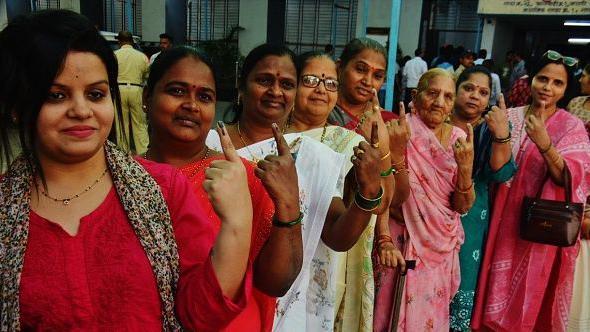
Across India, governments led by different political parties have rolled out cash-transfer schemes for women
Others were excluded because they exceeded the income or age limits, belonged to families with government employees, were already receiving money through another welfare scheme or came from households where more than one person was claiming the benefit.
Government data also showed nearly 29,000 men and about 8,000 government employees had received payments. Tatkare said the state was recovering this money but did not say how much had been repaid.
The scrutiny has renewed questions about the benefits – and long-term costs – of cash-transfer programmes.
Neeraj Hatekar, a welfare economist, says Ladki Bahin has made a real difference to women with low and irregular incomes.
Drawing on labour-force data, he says women in Maharashtra earn about 300 rupees a day on average. Even if they get work for 20 days a month, they earn only 6,000-7,000 rupees. Against that, he says, the scheme's 1,500-rupee monthly payment "is a big amount".
But he argues the same needs could be addressed by investing more in stronger public services such as healthcare, education, childcare centres and transport, so that women do not have to spend as much on them.
Economist Ajit Ranade says governments must also weigh the fiscal costs. "You might divert funds to these schemes and win an election," he says. "But what about the long-term damage [to the state's finances]? That is never audited."
The audit may shape how the scheme is run in future. For women like Bawaskar, however, the Ladki Bahin scheme has already changed their lives.
The money has not lifted her family out of poverty. But it has given her something she never had before: money deposited into an account in her own name.
"It's money of my own," she says. "That's what matters to me."

Source: “AOL Breaking”
